
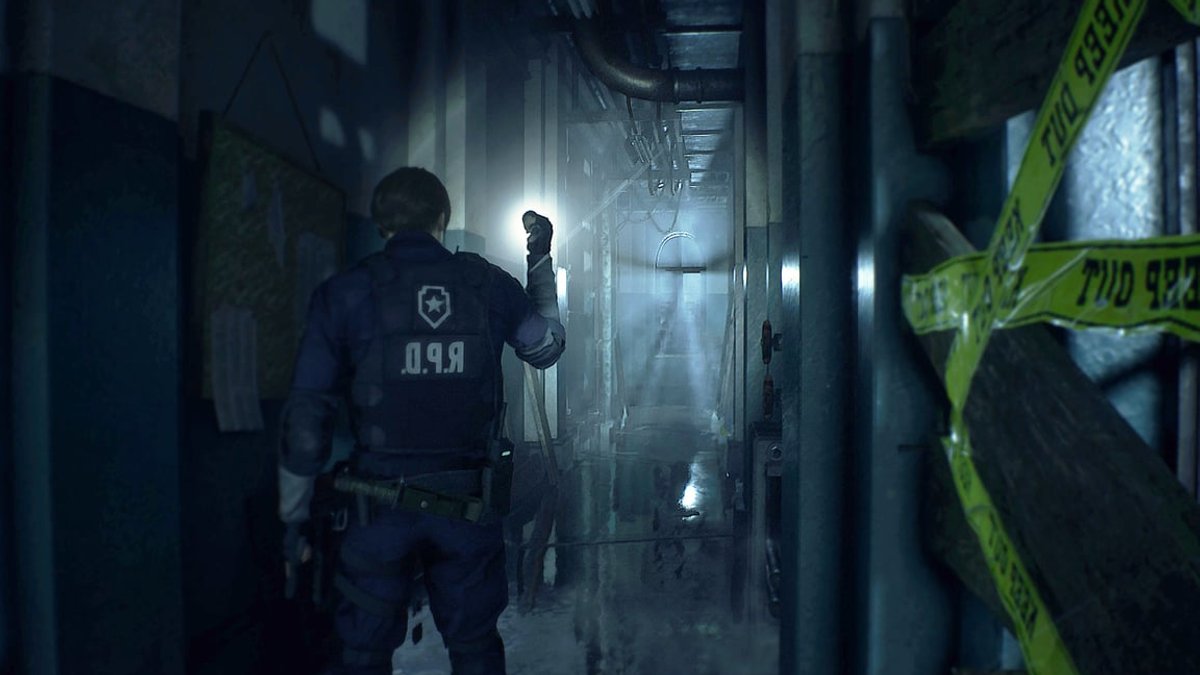
Resident Evil 2 remains a benchmark in survival-horror gaming, praised for how its low-resolution graphics and limited sound design intensify the experience.
The 1998 launch and its setting
The original title arrived in 1998, placing players in the fictional Midwestern town of Raccoon City, which has been overrun by a bioweapon released by the Umbrella Corporation.
Players assume the roles of Leon Kennedy, a rookie police officer on his first shift, and Claire Redfield, a college student searching for her brother Chris.
Both characters work through the same city but follow separate campaign paths, each revealing unique encounters and narrative details.
Fixed camera angles restrict the field of view, forcing players to anticipate threats around corners and in dimly lit hallways.
The game’s pre-rendered backgrounds and polygon-light models limit visual fidelity, yet they create a sense of place that players fill with personal imagination.
Design choices that shape atmosphere
Capcom’s development team used a modest polygon count and a small library of sound samples, a necessity imposed by the PlayStation’s disc capacity.
This scarcity meant that every visual cue and audio bite carried weight, encouraging players to read subtle details for clues.
Read Also: Mini Countryman vs original Range Rover
Camera positions often sit at awkward angles, deliberately hiding enemies until they emerge from shadows.
One notorious moment involves an arm reaching out from a police-department window, a surprise that still shocks newcomers.
The infamous Licker monster, rendered with the console’s limited geometry, has become an iconic horror image because its design leaves much to the mind’s eye.
Slow door-opening animations double as loading screens, granting a brief pause for the imagination to wonder what lies beyond.
These constraints turn the act of exploration into a psychological exercise rather than a purely visual one.
Players often report that the lack of high-definition textures heightens tension, as the brain supplies missing details.
While modern shooters prioritize smooth controls and clear visuals, Resident Evil 2 thrives on the uneasy feeling that comes from uncertainty.
Even the game’s clunky combat, with limited ammunition and unwieldy aiming, reinforces a sense of vulnerability.
Read Also: Royal Enfield Bullet 650 Preserves Soul Gains Power
Encounters with zombie hordes feel more like a struggle for survival than a triumphant battle.
In contrast, the 2019 remake upgrades lighting and texture quality, yet retains the core layout and narrative beats.
Capcom’s newer team applied contemporary rendering techniques to recreate the original’s atmosphere while making combat more responsive.
Despite graphical enhancements, the remake preserves the same fixed-camera moments that defined the 1998 version.
Both editions share the same puzzle design, such as aligning antique busts to direct sunlight onto a specific spot.
Multiple playthroughs are encouraged; the order in which a player tackles Leon or Claire first influences item locations and story revelations.
Remake reception and legacy
The 2019 remake received praise for modernizing visuals while honoring the original’s mood, proving that updated technology can coexist with classic design.