
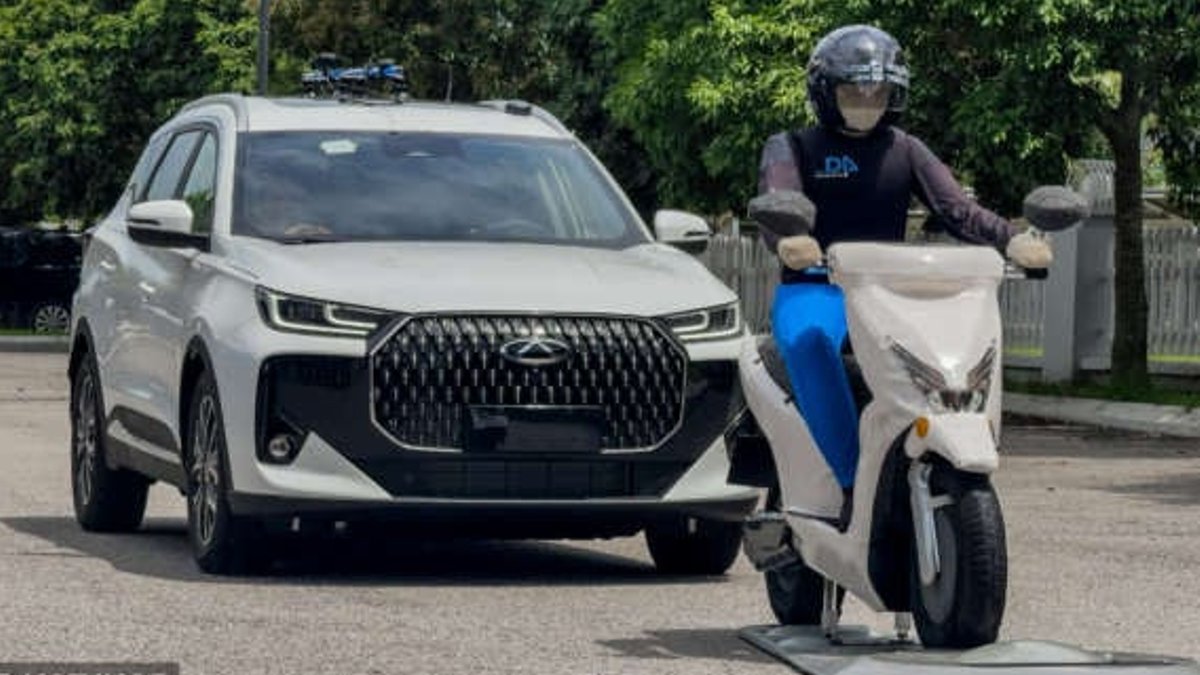
The ASEAN NCAP has announced its 2026-2030 protocol, which includes new tests for motorcycle autonomous emergency braking (AEB) systems. The agency will evaluate the motorcycle detection capabilities of AEB systems in various scenarios, including rear-ending, junction turns, cross junctions, and instances where the car veers into an oncoming motorcycle. In all instances, the car must either stop or take evasive action.
To simulate a motorcycle, ASEAN NCAP has commissioned an ADAS target designed to look like scooters commonly found in markets like Thailand and Indonesia. Supplied by either 4activeSystems (4a) from Austria or the China Automotive Engineering Research Institute (CAERI), the target is mounted on an omnidirectional platform and even has hub-mounted motors to simulate the rotation of the two wheels.
Motorcycle AEB Testing
The motorcycle AEB testing will add up to six points to the Motorcyclist Safety score, which has increased from 16 to 24 points.
Read Also: GWM Ora 5 Plus debuts in Thailand
The 2026-2030 protocol also introduces changes to the Safety Assist category, including the addition of lane support technologies and increased points for inter-city AEB testing. The maximum total points achievable in this category will be raised from 21 to 23.5 points.
Child Occupant Protection
The Child Occupant Protection (COP) category will also undergo changes, with the introduction of a new test for child presence detection (CPD) technologies. These technologies use radar, ultrasonic, or infrared sensors to detect the presence of a child in a vehicle.
ASEAN NCAP has commissioned a new dummy, the kiDS Child Presence Detection Subject (CPD-DS3), which can simulate the breathing rates and even the temperature of a baby up to 12 months old. With the additional points for CPD technologies, the maximum total COP score will be raised from 51 to 54 points.
Read Also: Malaysia rolls out ultra-fast EV charging on highways
Assessment Protocol Updates
The 2026-2030 protocol is the third revision to ASEAN NCAP’s assessment protocol, which debuted in 2012 with only Adult Occupant Protection (AOP) and COP testing and an optional side impact test. This was made compulsory from 2017, with the agency also beginning to award points for ABS, stability control, seat belt reminders, and blind spot monitors. In 2021, ASEAN NCAP brought the biggest update yet with the introduction of AEB testing and the addition of a separate Motorcycle Safety category.
The agency has also previewed its roadmap for the 2031-2035 protocol, which is aimed at moving cars away from collision prevention and mitigation and instead helping drivers avoid such instances entirely. To that end, the agency plans to combine AOP and COP assessments into a single Crash Protection category, while Safety Assist is set to be split into Safe Driving and Crash Avoidance categories. It’s currently seeking proposals from OEM and academic partners for its Anchor VI research grant, looking to gather essential evidence on regional road safety characteristics.