
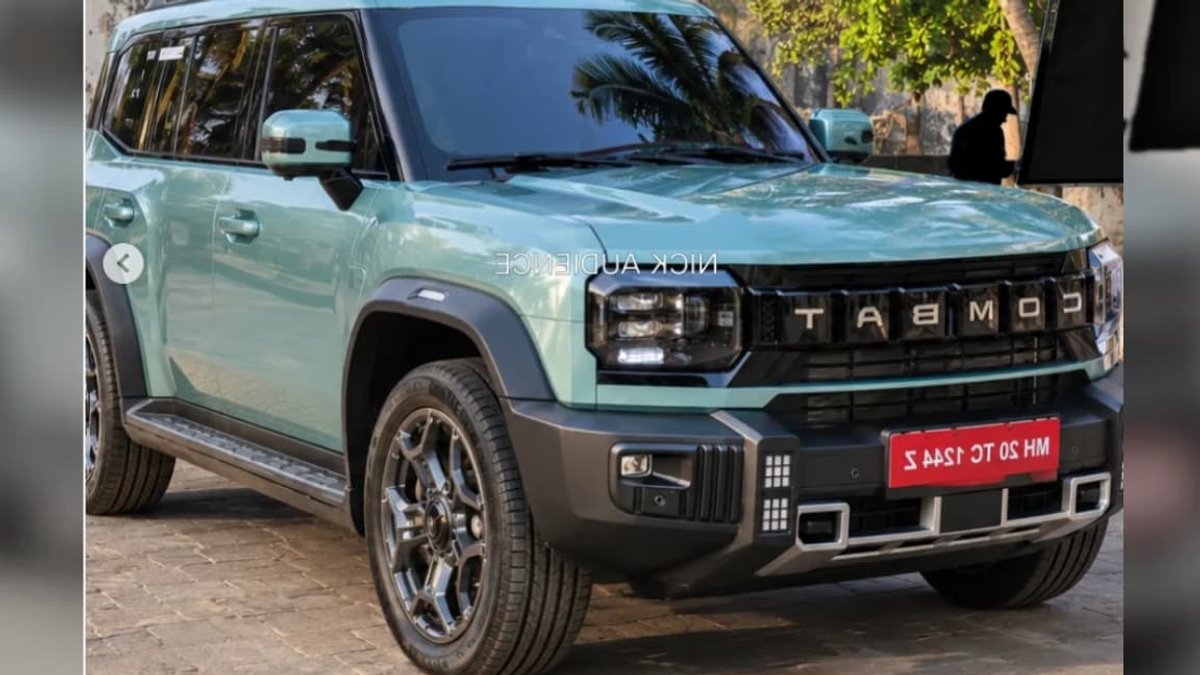
JSW Motors’ first SUV, the Combat, has been spotted without camouflage during an advertising shoot in Daman. The vehicle, based on the Jetour T2 i-DM, a five-seat plug-in hybrid, is set to debut in early December. This marks the first model from JSW Motors’ standalone car business, separate from its joint venture with MG.
Design and Dimensions
The Combat retains the T2’s upright bonnet, squared-off LED headlamps, chunky wheel-arch cladding, and black alloy wheels. Its tail lamps sit vertically on either side of a tailgate with a prominent square housing. The SUV measures nearly 4.8 meters long and about two meters wide, offering a 205mm ground clearance in its overseas specification.
The Combat’s design draws comparisons to the Defender, sparking debates among enthusiasts. Its dimensions and styling position it as a competitor to models like the Thar Roxx, Scorpio, and Majestor.
Interior and Features
Earlier spy shots revealed a dual-tone cabin, a freestanding 15.6-inch touchscreen, and a short gear selector. The overseas T2 i-DM features a 10.25-inch digital instrument cluster, wireless Apple CarPlay and Android Auto, a 50W wireless phone charger, and a 12-speaker Sony audio system. The Combat is expected to offer similar features, though local audio suppliers may vary.
Additional features include electrically adjustable, ventilated front seats, dual-zone climate control, a panoramic sunroof, and a heating and cooling compartment under the center armrest. Advanced safety features like adaptive cruise control, autonomous emergency braking, and blind-spot monitoring are also expected, though JSW has yet to confirm their inclusion in the India-spec model.
Performance and Powertrain
The Combat is anticipated to use a 1.5-litre turbo-petrol engine, two electric motors, and an 18.4kWh battery, paired with a three-speed hybrid transmission driving the front wheels. The overseas T2 i-DM delivers a combined 360PS and 610Nm, with an electric-only range of 90km on the NEDC cycle. It supports 6.6kW AC charging and 50kW DC charging, with a claimed 27-minute 30 to 80 percent top-up on DC.
The plug-in hybrid setup offers flexibility, allowing weekday commutes on electricity and weekend drives with the petrol engine. However, the key figure for Indian buyers will be the SUV’s fuel efficiency once the electric range is depleted, which will significantly influence its market appeal.