
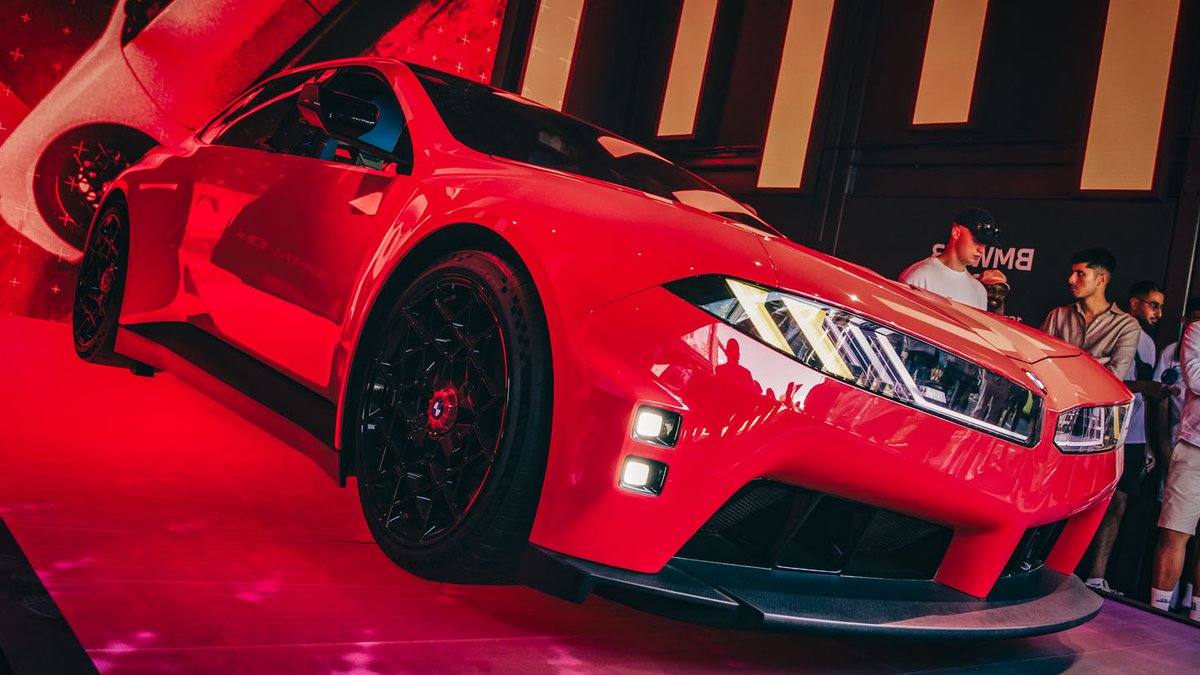
The next-generation BMW M3 will offer both electric and petrol powertrains when it arrives in 2026. The quad-motor electric version will share showroom space with a revised combustion variant featuring an updated 3.0-litre turbocharged straight-six engine. This engine maintains the current model’s 503bhp output while meeting stricter Euro 7 emissions standards. BMW’s engineers focused on using four electric motors to enhance vehicle responsiveness rather than pursuing higher horsepower figures.
The M3’s quad-motor configuration, managed by BMW’s “Heart of Joy” central computer, enables precise torque vectoring capabilities. This system can brake inner wheels and accelerate outer ones mid-corner, fundamentally changing how the car exits turns. The electric M3’s design, previewed by the M Concept Neue Klasse, incorporates flared fenders and a rear diffuser reminiscent of previous M3 generations while adapting to an electric vehicle’s proportions. BMW’s strategy involves creating internal competition between the electric and petrol variants, with the electric version designed to surpass the petrol model’s dynamic capabilities.
Table of Contents
- Why BMW Calls the Electric M3 Its ‘Natural Enemy’
- From Neue Klasse to M Concept: The Electric M3’s Design Evolution
- The Euro 7 Petrol M3: What’s New in the Updated Straight-Six
- Quad-Motor Tech Explained: How BMW’s ‘Heart of Joy’ Works
- Dynamic Advantages: How Four Motors Outperform Two (or One)
- Electric vs. Petrol M3: Performance, Sound, and Driver Engagement Compared
- The Buyer’s Dilemma: Who Should Choose the Electric M3?
- Milestones: The M3’s 40-Year Journey from E30 to Electric
- The Hidden Costs: Ownership Trade-Offs for Electric vs. Petrol M3
- What’s Next: How the Electric M3 Reshapes BMW’s Performance Future
Why BMW Calls the Electric M3 Its ‘Natural Enemy’
Frank van Meel, M division CEO, described the electric M3 as BMW’s “own natural enemy” during the Goodwood Festival of Speed. This characterization reflects how the car’s engineering could potentially overshadow the petrol variant’s appeal. Van Meel framed the rivalry as a deliberate contest where the electric M3’s quad-motor architecture doesn’t merely match the straight-six’s power but redefines performance characteristics. The target audience remains the same buyers who value the M3’s balance of daily usability and track precision, with the electric version promising enhanced adjustability.
The strategic approach carries obvious risks as BMW invests heavily in both powertrains, anticipating some buyers will switch from petrol to electric. The petrol M3’s updated straight-six retains its 503bhp output despite Euro 7 emissions requirements through turbocharging and exhaust system revisions. Meanwhile, the electric M3’s four motors focus on real-time adaptability rather than maximum power. Van Meel compared the system to a kickboxer’s technique, emphasizing control over brute force. This results in a vehicle that can transition between razor-sharp agility and high-speed stability in milliseconds, potentially making the petrol M3 feel comparatively limited.
This internal competition serves as a market hedge. If electric adoption accelerates, BMW will have a ready successor to the petrol M3. If not, the brand retains a halo model appealing to traditionalists. Either outcome ensures both variants must continually improve to outperform each other, ultimately benefiting drivers with enhanced choices.
From Neue Klasse to M Concept: The Electric M3’s Design Evolution
The M Concept Neue Klasse revealed last month provided the first look at the electric M3’s design language. The concept differs from both the current M3 and the forthcoming i3 saloon, with the i3 expected to prioritize aerodynamic efficiency through smooth, flowing lines. The electric M3 adopts a more aggressive stance, incorporating cues from past M3 generations to signal its performance intent. Flared fenders, a pronounced rear diffuser, and a wider track create a muscular presence that the i3’s sleeker silhouette lacks, accommodating the electric M3’s quad-motor layout and wider tires.
The concept’s front end features a reinterpreted kidney grille sealed for aerodynamic purposes while maintaining the M division’s vertical slats. Split headlights echo the current M3’s design but with a more angular execution. At the rear, taillights stretch across the car’s width in a single line, referencing the E92 M3’s horizontal light bar. The diffuser’s aggressive shaping hints at downforce capabilities. The side profile reveals a slightly lower, more coupe-like roofline compared to the i3’s, sacrificing some rear headroom for a sportier silhouette.
The electric M3 shares the Neue Klasse platform’s 800-volt architecture but features unique suspension and chassis tuning. The quad-motor setup enables near-perfect 50:50 weight distribution by relocating the battery pack lower and more centrally than in the i3. This layout improves handling while enabling dynamic torque vectoring, allowing independent power delivery to each wheel. The design combines engineering and aesthetics, creating a vehicle that appears fast while stationary but becomes even more impressive in motion.
Related: Honda seeks revival with fun new models
The Euro 7 Petrol M3: What’s New in the Updated Straight-Six
The next-generation BMW M3 Competition retains its 3.0-litre turbocharged straight-six engine while adapting to Euro 7 emissions standards. The updated S58 engine maintains its 503 horsepower and 479 lb-ft of torque through several revisions. A new 48-volt mild-hybrid system integrated into the eight-speed M Steptronic transmission provides a 12-horsepower boost during acceleration while smoothing power delivery. Recalibrated twin-scroll turbochargers with electronically controlled wastegates optimize backpressure under stricter emissions requirements. A revised exhaust manifold with thermal barrier coating lowers cold-start emissions, working alongside a close-coupled particulate filter and secondary air injection system to reduce emissions.
Engineers overhauled the cooling architecture, adding a third radiator. These changes result in identical performance to the outgoing model while meeting stricter emissions standards. The trade-offs include a slight weight increase due to hybrid and emissions hardware, with a marginal reduction in throttle response at low RPMs where the particulate filter’s backpressure is most noticeable.
Performance Comparison: Current vs. Euro 7 M3 Competition
| Metric | Current M3 Competition (S58) | Euro 7 M3 Competition (S58 Revised) |
|---|---|---|
| Power Output | 503 bhp @ 6,250 rpm | 503 bhp @ 6,250 rpm |
| Torque | 479 lb-ft @ 2,750-5,500 rpm | 479 lb-ft @ 2,750-5,500 rpm |
| 0-60 mph | 3.4 sec | Comparable to current model |
| Top Speed (Limited) | 155 mph | 155 mph |
| Emissions Standard | Euro 6d | Euro 7 |
| Hybrid System | None | 48V mild-hybrid |
| Curb Weight (Est.) | 3,805 lbs | Slightly higher than current model |
Quad-Motor Tech Explained: How BMW’s ‘Heart of Joy’ Works
The electric BMW M3 replaces the straight-six with a quad-motor configuration rarely seen in production vehicles. BMW’s approach prioritizes precision over power, using each motor as a precise tool rather than a brute-force component. The front axle features two smaller, high-revving motors (one per wheel), while the rear axle employs two larger, torque-dense units. This asymmetry mimics the petrol M3’s front-engine, rear-drive balance while enabling capabilities beyond traditional drivetrains.
The “Heart of Joy” central computer processes 3,000 data points per second, including wheel speed, steering angle, lateral G-forces, and driver inputs. The system predicts and reacts to driving conditions. When entering a corner, it pre-loads torque to the outer rear motor while applying regenerative braking to the inner front wheel, effectively rotating the car into the turn before the driver inputs steering. This dynamic pre-emption adjusts power delivery faster than any mechanical differential could match. BMW claims the system enhances cornering capabilities, aligning with capabilities demonstrated in the Vision Driving Experience prototype.
The quad-motor setup focuses on control rather than maximum power. The system can distribute torque in unconventional ways. For wet exit ramps, it can send 80% of power to the rear axle while using front motors to scrub speed. For mid-corner rotation, it can pulse torque to the outer rear wheel while braking the inner front, effectively pivoting the chassis around its center of gravity. Van Meel noted that the system doesn’t need to use all motors simultaneously—it only needs to know when and where to apply power.
How the Quad-Motor Setup Enhances Trends
- Front Axle: Two compact, high-revving motors (estimated 150 kW each) enable independent torque vectoring, dynamically adjusting power to each wheel.
- Rear Axle: Two larger, torque-dense motors (estimated 200 kW each) provide the bulk of acceleration, with the ability to overdrive the outer wheel for sharper turn-in.
- Regenerative Braking: The Heart of Joy can apply significant deceleration through regen alone, using the front motors to stabilize the car under braking.
- Torque Distribution: In a high-speed corner, the system can send torque to specific wheels while using others to fine-tune rotation.
- Predictive Control: By analyzing steering angle and throttle position, the Heart of Joy pre-loads torque to optimize response.
The result creates a vehicle that feels more responsive than any previous petrol M3. The quad-motor setup doesn’t merely outperform the straight-six—it redefines driving engagement through software-controlled precision.
Dynamic Advantages: How Four Motors Outperform Two (or One)
The electric M3’s quad-motor layout fundamentally changes how a performance car translates driver input into motion. Traditional all-wheel-drive systems like BMW’s xDrive split torque between axles via mechanical differentials, with some models adding limited-slip units for modest torque vectoring. These setups face physical constraints as torque can only be redistributed within tire grip limits, and mechanical losses reduce efficiency. The electric M3’s four independent motors eliminate these compromises, allowing each wheel to accelerate or brake independently for precise control.
On wet tracks, the system detects understeer before the driver does. Instead of waiting for stability control, it preemptively adjusts torque distribution to optimize cornering. This approach is both faster and more intuitive, masking the car’s weight with software that reacts in milliseconds. The petrol M3’s rear-biased xDrive with mechanical limited-slip differential provides excellent performance but remains reactive rather than predictive, unable to match the electric M3’s ability to modulate torque at all four corners simultaneously.
The advantages extend beyond cornering. At track exits, the quad-motor setup allows the electric M3 to deploy torque in ways that optimize acceleration. The petrol M3’s straight-six, despite its linear power delivery, cannot match this adaptability. Even with launch control, its xDrive system must balance traction against wheelspin, while the electric M3 can send precise torque pulses to each wheel for optimized acceleration. On public roads, this translates to effortless overtakes and confident mid-corner adjustments where the petrol M3’s mechanical brilliance is outpaced by the electric version’s digital precision.
Related: Inside firm improving engines to accelerate net zero
Electric vs. Petrol M3: Performance, Sound, and Driver Engagement Compared
The electric M3 challenges the petrol version by redefining performance sedan capabilities. BMW’s M division refined the straight-six’s character over decades, creating its distinctive howl under acceleration, gearshift feedback, and linear power delivery. The electric M3 uses software to simulate these sensory cues, including simulated gear shifts, artificial engine notes, and haptic steering wheel feedback. These features attempt to bridge the gap between tradition and innovation, though their effectiveness remains subjective.
Frank van Meel argues that the electric M3’s driving trends surpass the petrol version’s not despite its silence but because of its precision. He told Autocar, “The petrol M3 is a masterpiece of mechanical engineering, but the electric M3 is a masterpiece of software engineering. We’re not just chasing lap times—we’re chasing the feeling of connection between driver and car.” This connection appears in the numbers. While official performance figures for the production electric M3 remain undisclosed, the M Concept Neue Klasse provides clues. Prototype data suggests a 0-60 mph time under 3.5 seconds—faster than the current petrol M3’s 3.8 seconds—with a top speed electronically limited to 155 mph (or 180 mph with the optional M Driver’s Package). Nürburgring lap times are projected to be competitive with the petrol M3.
Performance extends beyond acceleration and top speed. The electric M3’s real advantage lies in its adaptability to various driving scenarios. On twisting backroads, the quad-motor setup enables sharper turn-in and more adjustable mid-corner balance, while the petrol M3’s rear-biased xDrive and mechanical differentials offer a more analog experience. The following table compares key aspects of both powertrains.
| Aspect | Electric M3 (Quad-Motor) | Petrol M3 (Straight-Six) |
|---|---|---|
| 0-60 mph | Under 3.5 sec (projected) | 3.8 sec (current gen) |
| Top Speed | 155 mph (180 mph with M Driver’s Package) | 155 mph (180 mph with M Driver’s Package) |
| Torque Vectoring | Independent control of each wheel, predictive adjustments | Mechanical limited-slip differential, reactive adjustments |
| Sound | Simulated engine notes, adjustable volume and tone | Natural straight-six exhaust note, turbocharger whine |
| Driver Engagement | Software-driven precision, customizable trends | Mechanical feedback, traditional throttle and gearshift feel |
| Weight | Approx. 2,200 kg (battery-inclusive) | Approx. 1,700 kg (current gen) |
The electric M3’s weight presents its most obvious challenge, though BMW mitigates this with a low center of gravity and chassis tuned for even mass distribution. The petrol M3 remains a benchmark for driver engagement with its linear power delivery and exhaust note. Van Meel’s argument that the electric M3’s trends are more engaging due to their adaptability carries weight. The quad-motor system doesn’t merely replicate the petrol M3’s capabilities—it expands them with a level of adjustability mechanical systems cannot match. Whether this proves sufficient to win over purists remains uncertain, but the electric M3 emerges as the more capable machine on paper.
The Buyer’s Dilemma: Who Should Choose the Electric M3?
The electric M3 represents a different philosophy rather than just a different powertrain. Buyers prioritizing immediate response and advanced technology will find the quad-motor setup advantageous. Instant torque from zero rpm transforms acceleration into something closer to reflex than mechanical process. The electric M3’s low-end power delivery is so linear and predictable that throttle modulation becomes almost instinctive, rewarding precision on tight circuits or twisty roads. Additional tech features include adaptive torque vectoring, predictive energy recuperation, and over-the-air updates that refine handling algorithms, making the electric M3 appealing to drivers who want their vehicle to evolve.
The petrol M3 retains undeniable appeal through its straight-six exhaust note, which remains integral to the M3’s identity. For enthusiasts who associate emotion with sound, the electric M3’s artificial soundtrack may never fully replace the visceral connection of a naturally aspirated or turbocharged engine. Charging infrastructure also presents hurdles. While home charging addresses most daily needs, long-distance touring in an electric M3 requires more planning than a petrol variant that can refuel quickly at any gas station. The petrol M3 carries 40 years of heritage, and for some buyers, this emotional connection outweighs technical specifications.
The electric M3 excels for track days. Its independent torque control at each wheel enables sharper turn-in and more adjustable mid-corner balance, while regenerative braking reduces reliance on traditional brakes, minimizing fade during extended sessions. Daily driving also favors the electric variant with its smooth power delivery, reduced maintenance needs, and overnight charging convenience. For long-distance touring, the petrol M3 currently holds an advantage until fast-charging networks become more reliable. BMW’s internal competition isn’t about declaring a winner but about giving buyers the freedom to choose the M3 that aligns with their priorities, whether that means adopting the future or honoring the past.
Milestones: The M3’s 40-Year Journey from E30 to Electric
The M3’s evolution demonstrates relentless reinvention, with each generation pushing performance sedan boundaries. What began as a homologation special for touring car racing became a benchmark for driver engagement, technological innovation, and motorsport-derived engineering. The shift to electrification represents the next logical step rather than a departure from this legacy. BMW’s early electric performance experiments, including the i8 hybrid and i4 M50, laid groundwork for the electric M3, proving that sustainability and excitement can coexist. With the M Concept Neue Klasse previewing the electric M3’s design and the forthcoming i3 saloon serving as its technical foundation, BMW prepares to redefine the segment once again.
This timeline highlights key moments in the M3’s history.
Related: UK warns of critical threat to domestic EVs
- 1986: The E30 M3 debuts as a homologation special for Group A touring car racing. Its 2.3-liter four-cylinder S14 engine produces 192 horsepower, with advantages coming from lightweight construction, aggressive aerodynamics, and a rear-wheel-drive chassis tuned for precision. The E30 M3 wins more races than any other car in its class, establishing its reputation as a driver’s machine.
- 1992: The E36 M3 introduces a 3.0-liter inline-six engine, marking the first time the M3 abandons its four-cylinder roots. With 240 horsepower, it offers more refinement than its predecessor while retaining sharp handling. The E36 also brings the M3 to the U.S. market, expanding its appeal beyond Europe.
- 2000: The E46 M3 arrives with the high-revving 3.2-liter S54 engine, a masterpiece of naturally aspirated engineering. Producing 333 horsepower, it becomes the last M3 to feature a manual transmission as standard, appealing to purists. The E46 is widely regarded as one of the best-handling M3s ever made, thanks to its balanced chassis and communicative steering.
- 2014: The F80 M3 reintroduces turbocharging with a 3.0-liter twin-turbo straight-six generating 425 horsepower. It becomes the first M3 to offer all-wheel drive via the M3 Competition xDrive, reflecting BMW’s shift toward all-weather capability. The F80 also marks the end of the coupe body style as the M4 nameplate takes over two-door duties.
- 2020: The G80 M3 debuts with a refreshed version of the S58 twin-turbo straight-six, now producing 473 horsepower in standard form and 503 in Competition guise. It becomes the first M3 to offer an automatic transmission as the only option in some markets, reflecting the industry’s shift away from manuals. The G80 also introduces an optional carbon-fiber driveshaft, reducing rotational mass for quicker acceleration.
- 2022: BMW unveils the i4 M50, its first all-electric performance car under the M badge. With 536 horsepower and a 0-60 mph time of 3.7 seconds, it demonstrates that electric powertrains can deliver M-level thrills. The i4 M50’s dual-motor setup previews technology that will underpin the electric M3, including torque vectoring and adaptive regenerative braking.
- 2023: The M Concept Neue Klasse is revealed, previewing the design and technology of the next-generation electric M3. Its muscular stance, aggressive front grille, and quad-motor layout signal BMW’s intent to make the electric M3 as visceral as its petrol-powered predecessors. The concept also introduces the “Heart of Joy” central computer, which manages torque distribution across all four wheels for unparalleled agility.
- 2026: The electric M3 arrives, built on BMW’s Neue Klasse architecture. It shares its platform with the forthcoming i3 saloon but is engineered to deliver M-level performance with four motors providing independent torque control at each wheel. The petrol M3 continues alongside it, updated to meet Euro 7 emissions standards without sacrificing power. For the first time, buyers will choose between the M3’s past and its future.
The electric M3 isn’t merely another chapter in the car’s history—it represents a fundamental reimagining of what an M car can be. Through electrification, BMW isn’t abandoning its heritage but ensuring the M3 remains relevant in a world where performance and sustainability must coexist. The next 40 years of the M3 will depend on how well it adapts to this new reality, and if the M Concept Neue Klasse provides any indication, the future appears promising.
The Hidden Costs: Ownership Trade-Offs for Electric vs. Petrol M3
The electric M3’s starting price is expected to be around $95,000—approximately $15,000 more than the petrol variant—though federal tax credits could reduce this premium by up to $7,500. State incentives vary, with California offering a $2,000 rebate and HOV-lane access, while Texas provides no additional benefits. Leasing may further reduce costs, with BMW Financial Services reportedly structuring residual values to keep monthly payments within $50 of the petrol M3’s.
Long-term cost differences depend on energy, maintenance, and depreciation. Charging at home with a 240-volt Level 2 setup costs about $0.12 per kWh, resulting in roughly $12 for a full 100-kWh battery. A petrol M3 averaging 22 mpg at $3.50 per gallon spends $16 to cover the same 220-mile range. Public fast-charging networks like Electrify America add convenience but can double per-mile costs if used exclusively. Maintenance favors the EV with no oil changes, spark plugs, or timing belts required, though the quad-motor system’s complexity could lead to higher repair costs after warranty. Battery degradation remains uncertain, though BMW’s 8-year/100,000-mile warranty covers 70% capacity, and real-world data from older i4 M50 models shows minimal loss in the first five years.
Resale value presents the biggest unknown. The petrol M3 has historically retained 55-60% of its value after three years, while early electric performance cars like the Tesla Model 3 Performance have dipped to 45-50%. BMW’s brand strength may help the electric M3’s depreciation, but the used market’s demand for high-voltage track cars remains unproven. Charging infrastructure also adds hidden costs, with home wallbox installation ranging from $1,200 to $2,000, and public networks still facing reliability issues—a 2025 J.D. Power study found 1 in 5 fast-charging sessions failed in urban areas. Track-day limitations are more pronounced for the electric M3, as heat buildup in the battery and motors forces mandatory cooldown laps after three hot laps, a constraint the petrol M3 avoids entirely.
What’s Next: How the Electric M3 Reshapes BMW’s Performance Future
The electric M3 serves as a template for BMW’s entire M division. Frank van Meel confirmed the quad-motor architecture will underpin the next M4 and M5, with the M4’s shorter wheelbase promising even sharper responses from the torque-vectoring system. The M5, traditionally a V8-powered model, will likely adopt a dual-motor setup for the front axle to maintain its all-wheel-drive legacy while reducing drivetrain weight. Hybrid variants are already in development, with a plug-in M3 rumored to pair the updated 3.0-litre straight-six with a single electric motor for a combined output around 550 horsepower. This setup would retain the petrol engine’s linear power delivery while adding electric-only range, providing a transitional option for buyers reluctant to abandon internal combustion.
Van Meel’s vision extends beyond powertrains. The “Heart of Joy” central computer, which manages the electric M3’s four motors, will evolve into a platform for adaptive performance modes. Future M cars could toggle between different driving characteristics. Synthetic fuels may play a niche role, likely limited to track-focused M models. These fuels, developed through BMW’s partnership with Porsche, could extend the straight-six’s life in motorsport applications, though van Meel has ruled out their use in road cars beyond 2030.
The electric M3 also signals a shift in BMW’s manufacturing strategy. The Neue Klasse platform, debuting with the i3 saloon later this year, will underpin all M cars by 2028. This modular architecture allows for variable battery sizes without altering wheelbase or crash structure. The biggest challenge remains weight, with the electric M3’s curb weight expected to be significantly higher than the petrol variant. To compensate, BMW is exploring carbon-fiber reinforced plastic for body panels and aluminum subframes. Engineers have also hinted at performance modes that temporarily disable certain comfort features to reduce electrical load during spirited driving.
By 2030, BMW’s M lineup will likely consist of three pillars: full-electric models (M3, M4, M5), hybrid plug-ins (M2, M8), and possibly a single petrol-powered halo car. The electric M3’s success will determine how quickly the transition accelerates. If buyers accept its dynamic advantages, the straight-six could become a boutique option within five years. If not, BMW will maintain both powertrains in parallel, letting the market decide. Either way, the internal competition van Meel describes isn’t just a challenge—it’s becoming the new standard for performance engineering.
Frequently Asked Questions
Is the 2026 electric BMW M3 faster than the petrol M3 Competition?
Yes, the electric M3 (likely called iM3) is expected to out-accelerate the petrol M3 Competition due to instant torque from its quad-motor setup. BMW’s EV platform allows for quicker 0-60 mph times, though top speed may be limited by software.
How does the electric BMW M3’s range compare to the petrol version’s fuel efficiency?
The electric M3’s range will depend on battery size, but early estimates suggest 250–300 miles per charge under real-world conditions. The petrol M3 Competition averages 18–22 MPG combined, making the EV more efficient for daily driving but requiring charging stops on long trips.
Does the electric BMW M3 have better handling than the petrol M3?
The electric M3’s lower center of gravity (from battery placement) and precise torque vectoring from its quad motors should improve cornering agility. However, the petrol M3’s lighter weight and rear-biased power delivery may still feel more playful to enthusiasts.
How much more expensive will the 2026 electric BMW M3 be than the petrol model?
Pricing hasn’t been confirmed, but the electric M3 is expected to cost $10,000–$15,000 more than the petrol M3 Competition (currently ~$80,000). Tax credits or incentives could offset some of the premium for EV buyers.
Can the electric BMW M3 drift like the petrol M3?
Drifting is possible but more challenging in the electric M3 due to its all-wheel-drive system and torque vectoring, which prioritize stability. The petrol M3’s rear-wheel-drive (or xDrive) setup is better suited for controlled slides, though software tweaks may allow some EV drifting.
How long does it take to charge the 2026 electric BMW M3?
Using a 200+ kW DC fast charger, the electric M3 should recharge from 10% to 80% in about 20–30 minutes. A full charge at home on a Level 2 charger (11–22 kW) will take roughly 8–12 hours.
Will the electric BMW M3 have a manual transmission option?
No, the electric M3 will not offer a manual transmission, as EVs rely on single-speed gearboxes for efficiency. The petrol M3 Competition may retain its 6-speed manual option for purists, but this hasn’t been confirmed for 2026.
Is the electric BMW M3 more reliable than the petrol M3 long-term?
Electric powertrains generally have fewer moving parts, reducing maintenance needs (no oil changes, spark plugs, etc.). However, battery degradation and potential motor wear over 100,000+ miles remain factors, while petrol engines have a longer track record for longevity.