
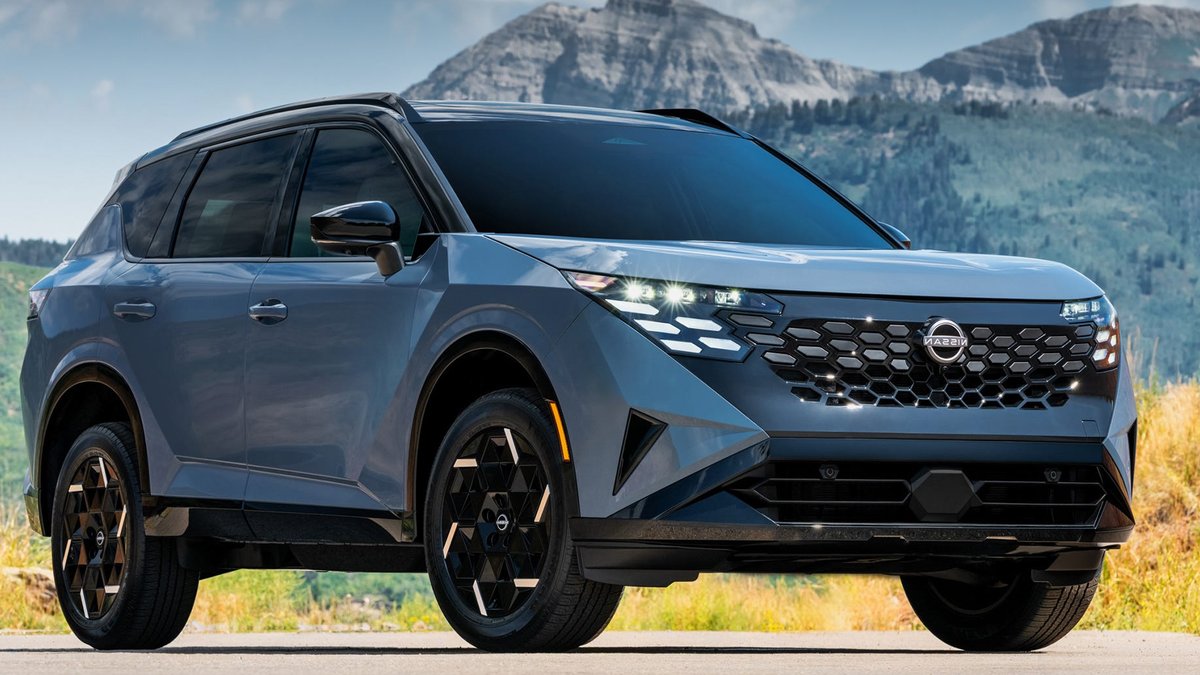
The 2027 Nissan Rogue e-Power hybrid SUV marks the automaker’s long-awaited entry into the U.S. hybrid market, arriving after years of relying on internal combustion engines or pure electric vehicles. A first drive of a near-production prototype in Park City, Utah, revealed a powertrain designed to mimic the smoothness of an electric vehicle while using a gasoline engine only to generate electricity.
The Rogue’s e-Power system is a series hybrid, meaning the 1.5-liter turbocharged inline-three engine never directly powers the wheels. Instead, it runs in a narrow RPM band to charge a battery, which then feeds an electric motor driving the front wheels. A second motor handles all-wheel drive, though Nissan insists the engine will never be clutched directly to the wheels—unlike Honda’s hybrid setup, which occasionally engages mechanical drive for efficiency at higher speeds.
Total output is 225 horsepower, with EPA-estimated fuel economy of 40/36/38 mpg for city/highway/combined. The system’s refinement is its standout feature: the prototype was exceptionally quiet, with acceleration described as “instant and steady,” free of the torque dips common in traditional hybrids.
One-pedal driving is another highlight. Lifting off the accelerator engages regenerative braking, slowing the SUV without the brake pedal. While not as aggressive as an EV’s deceleration, it stops the car smoothly—a feature more drivers associate with electric vehicles. A separate Smooth Stop mode further refines braking by automatically feathering the pedal, though its practicality remains unclear for most drivers.
Nissan’s adaptive cruise control, ProPilot Assist, has been updated to allow hands-free driving in slow traffic, a rare capability in hybrids. The system’s thermal management keeps components in their most efficient operating zone, particularly important for highway efficiency.
Pricing and lineup details revealed
The 2027 Rogue Hybrid lineup starts at $37,065 for the base SV trim, with the SR at $39,065 and the top-tier Platinum at $45,065. Early deliveries this fall will be SR models with the Tech package, adding a larger touchscreen, an improved parking camera, ProPilot Assist, and a panoramic sunroof, for $43,065. Non-hybrid Rogue models will continue through 2027 before transitioning to the next-generation body style in 2028.
Nissan’s delay in offering hybrids in North America has been a strategic misstep, the company now admits. While it has sold hybrids elsewhere, including the Qashqai with e-Power, and Mitsubishi’s plug-in hybrid tech is already available in the U.S., the Rogue’s arrival aims to close that gap within two years. The challenge now is convincing customers that e-Power’s series-hybrid approach, with its fully electric drive and gasoline engine acting solely as a generator, is worth the investment.
How e-Power redefines hybrid driving
Unlike traditional hybrids that blend electric and gasoline power, e-Power eliminates the lag between initial acceleration and torque fill. The goal was to create a driving experience closer to an EV, something Nissan’s engineers achieved, at least in the prototype.
Inside the cabin, the focus is on practicality. The Rogue’s hybrid powertrain doesn’t require a larger battery or heavy components, keeping the SUV’s size and cargo space intact. The $37,065 starting price positions it competitively against rivals like the Toyota RAV4 Hybrid, though its all-wheel-drive capability and refined ride may justify the premium.
The prototype’s quiet cabin and seamless acceleration stood out during the test drive.
One detail that stood out was the powertrain’s compactness. The new e-Power system integrates the motor, battery, inverter, generator, and engine into a single unit, reducing weight and complexity. Thermal management ensures the system stays in its most efficient state, particularly important for highway driving where hybrids often lose ground to EVs.
Production Timeline and Market Position
The schedule aligns with the company’s goal to launch the e-Power model in the United States early the following year.