
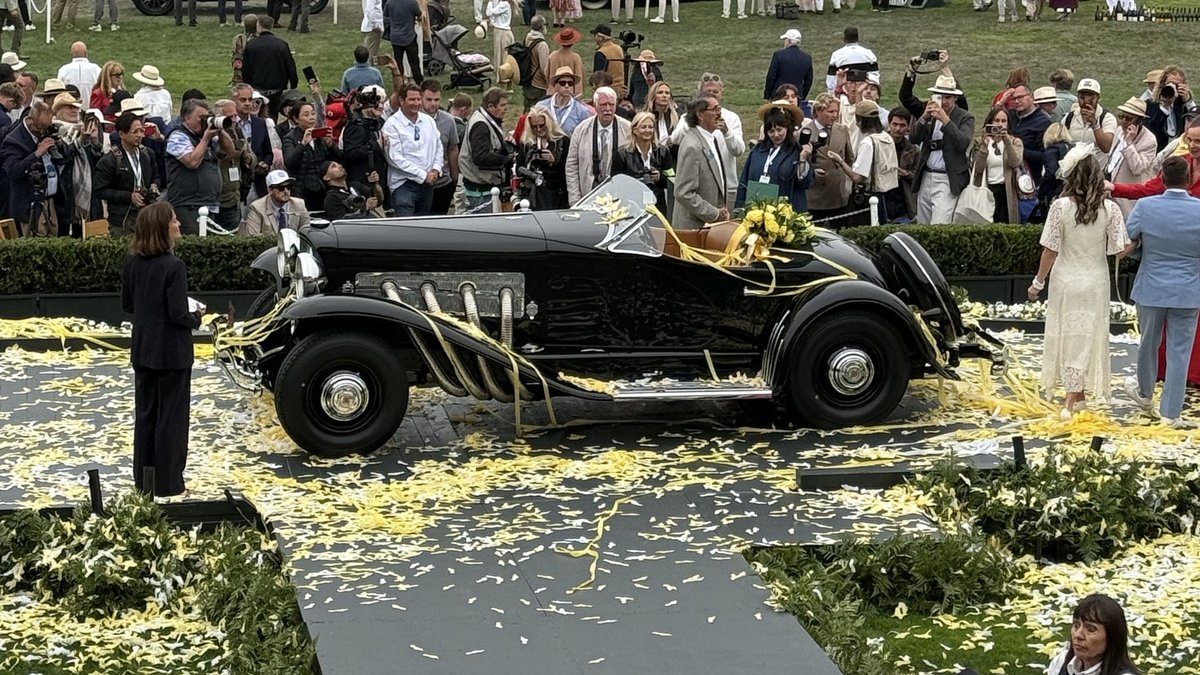
The 2026 Pebble Beach Concours d’Elegance concluded its Monterey Car Week celebrations Sunday, awarding Best of Show to a 1935 Duesenberg SSJ Special Speedster owned by Harry Yeaggy of Cincinnati, Ohio. The prewar vehicle was adorned with confetti as it entered the stage area near the 18th hole of Pebble Beach Golf Links.
This year’s gathering marked the 75th iteration of the Pebble Beach Concours d’Elegance, an event held on California’s Monterey Peninsula since 1950 and widely viewed as one of the globe’s most prestigious classic car exhibitions.
The victorious Duesenberg SSJ is among only two Special Speedsters designed by Herb Newport and constructed on a shortened 125-inch wheelbase. One was famously linked to actor Gary Cooper, while the other, the car that prevailed at Pebble Beach, was linked to film star Clark Gable, a known Duesenberg devotee.
Each Special Speedster was equipped with supercharged straight-eight engines and dual carburetors, delivering close to 400 horsepower, an exceptional output for the time. Their blend of power and scarcity has rendered them among the most celebrated American automobiles ever produced.
The Pebble Beach winner had belonged to the Ferrara family for over sixty years before eventually passing to Yeaggy. The vehicle was recently restored to its original black lacquer finish over light saddle leather, a presentation that impressed judges for its faithful recreation of the Duesenberg’s period appearance.
Read Also: Nissan’s new hybrid Rogue SUV blends EV-like smoothness with gas
Former General Motors designer and renowned automotive critic Robert Cumberford once had the chance to drive a 1935 Duesenberg SSJ roadster. He was impressed by the car’s surprisingly modern performance and ride quality, though far less so by its three-speed nonsynchromesh gearbox.
“The twin-cam, four-valve engine was ahead of its time in 1928, but the car was an anachronism by the end,” Cumberford wrote.
Duesenberg had grand ambitions for the Model J, reportedly aiming to sell about 500 cars annually. However, actual production fell far short during the model’s 1928–1937 run. The SSJ, with only two produced, was the rarest of the breed.
“Acceleration from rest would have been hampered by the car’s great weight and clumsy gearbox, but there was plenty of shove available in top gear,” Cumberford wrote after driving one. “Some observers estimated a 160-mph top speed for this model, although the poor aerodynamics of clamshell fenders make that unlikely.”